
As tensions escalated between India and Pakistan following the deadly Pahalgam terror attack, Iran reached out to both countries, urging de-escalation. Saudi Arabia also expressed concern, with its foreign minister engaging in phone conversations with his Indian and Pakistani counterparts. Iran's foreign minister, Seyed Abbas Araghchi, emphasized the importance of bilateral relations, stating Tehran's willingness to "forge greater understanding" at this critical time. Saudi Arabia's foreign minister, Faisal bin Farhan Al Saud, spoke with both India's External Affairs Minister S Jaishankar and Pakistan's Foreign Minister Mohammad Ishaq Dar. Amidst heightened tensions, India has taken a series of punitive measures against Pakistan, including suspending the Indus Waters Treaty and downgrading diplomatic ties. Pakistan responded by shutting its airspace to Indian airliners and suspending all trade. Both countries exchanged warnings, with Pakistan emphasizing its commitment to "respond firmly to any aggression."

'In the last 55 years India and Pakistan have gone to wars, but nobody spoke about scrapping the Indus Waters Treaty.'

Puri said Pakistan was a country in "terminal decline" periodically using terrorism as an instrument of state policy.

Pakistan has offered to join any neutral and transparent probe into the Pahalgam terrorist attack that killed 26 people. Prime Minister Shehbaz Sharif also warned India against any attempt to stop, reduce or divert the flow of water belonging to Pakistan, saying any such action would be responded to with full force and might. Sharif said Pakistan has always condemned terrorism in all its forms and manifestations and has endured immense loss of over 90,000 casualties and economic losses exceeding USD 600 billion. He also reiterated Pakistan's support for the right of self-determination of the Kashmiri people.

Since signing of the treaty, a total of 118 such tours on both the sides have been undertaken.

The US has issued a 'Do Not Travel' advisory for Jammu and Kashmir citing potential for terrorist attacks and violent civil unrest. The advisory, issued on Wednesday, comes a day after a deadly terror attack in Pahalgam that killed 26 people, mostly tourists. The advisory also warns against traveling within 10 kilometers of the India-Pakistan border.
The United States on Thursday said it supports India's right to defend itself and its fight against terrorism as US Defence Secretary Pete Hegseth dialled Defence Minister Rajnath Singh amid rising tensions between India and Pakistan over the Pahalgam terror attack.

Emboldened by the international court of justice's interim ruling on the Kishenganga project, Pakistan now plans to take the Nimoo-Bazgo hydropower project being built by India on the Indus river to the world court, according to media reports.

Secretary of Pakistan's ministry of water resources Khawaja Shumail said: "We have neither concern nor objection if India diverts water of eastern rivers and supplies it to its people or uses it for other purposes, as the IWT allows it to do so."
'China could intentionally release excess water.' 'The North East is already flood-prone during the monsoon, and even a controlled release from Chinese dams (during the monsoon) could worsen flooding.'
Pakistan has decided to approach the World Bank to request the appointment of a neutral expert to resolve a dispute with India over the Kishanganga hydroelectric project if bilateral efforts fail to settle the matter, according to a media report.

Former Pakistan foreign minister Bilawal Bhutto had acknowledged his country's tango with terror operatives, saying that Pakistan has a past.

Main imports from the neighbouring country during April-January 2024-25 included fruits and nuts (USD 0.08 million), certain oil seeds and medicinal plants (USD 0.26 million), and organic chemicals.

India's Permanent Representative to the UN Ambassador Parvathaneni Harish said that the Indian sub-continent offers a "stark contrast" in terms of progress, prosperity and development models.

'Engaging with Pakistan at this stage sends out a message that undermines the sentiments of the people of India who stand firmly against any compromise on national security.'

India has revoked all visas issued to Pakistani nationals effective April 27, advised Indian nationals in Pakistan to return home, and suspended visa services to Pakistani nationals. The move comes in retaliation to the Pahalgam terror attack that killed 26 people and alleged cross-border links to the attack. This escalation follows India's previous actions against Pakistan, including expelling Pakistani military attaches, suspending the Indus Water Treaty, and shutting down the Attari land-transit post.

'What must the Indian Air Force pilots -- who destroyed terror bases in Pakistan using BrahMos missiles' -- be thinking?'
Regarding the possibility of talks, the minister said he was not aware of any such potential engagements.

India's Air Chief Marshal A P Singh met Prime Minister Narendra Modi on Sunday to discuss the security situation arising from escalating tensions with Pakistan. The meeting comes after a similar briefing by the Navy Chief on the situation in the Arabian Sea. This follows a deadly terror attack in Pahalgam, which India has blamed on Pakistan. India has taken several retaliatory measures, including suspending the Indus Waters Treaty and banning imports from Pakistan.
Both the countries agreed to undertake the Treaty mandated tours of both the Indus Commissioners in the Indus basin on both sides, the ministry said in a statement in New Delhi.

Pakistan criticised the laying of foundation stones for the construction of the Rattle and Kwar Hydroelectric Projects on the Chenab River in Kashmir.

The three-day meeting between the two commissioners of PCIW completed discussions on all agenda items on Wednesday.
Pakistan has been opposing the construction of the Kishanganga hydropower project on Ganga river in Kashmir, which is called Neelum upon entering Pakistan. Pakistan has said that the diversion of the waters of the Neelum is not allowed under the 1960 Indus Waters Treaty, and that it will face a 27 per cent water deficit when the project gets completed.

Villagers living near the International Border and Line of Control in Jammu are on high alert following the recent terror attack in Pahalgam, preparing underground bunkers and accelerating crop harvesting. The incident has heightened security concerns despite a renewed ceasefire agreement between India and Pakistan in 2021. Residents are demanding swift action against the perpetrators and their handlers.
Gadkari said the water of these 'Eastern rivers' will be diverted and supplied to Jammu and Kashmir and Punjab.

In 2025, India launched Operation Sindoor, a multi-domain combat mission against Pakistan in response to cross-border terrorism. The operation involved precision strikes, military retaliation, and diplomatic measures, marking a significant shift in India's security policy.

The Pakistan Army has vowed to respond to Indian air strikes that targeted locations in Pakistan-occupied Kashmir and Punjab. The strikes were carried out from within Indian airspace, according to the army spokesman, who said that Pakistan will respond at a time and place of its choosing. The army is currently assessing the damage caused by the strikes.
Abdul Waheed was brought from Srinagar by the Jammu and Kashmir police for his repatriation to Pakistan.

The statement came hours after Prime Minister Narendra Modi on Tuesday told the top defence brass that the armed forces have "complete operational freedom" to decide on the mode, targets and timing of India's response to the Pahalgam terror attack, government sources said.
Rejecting recent allegations by Pakistan of non-adherence to the Indus Water Treaty, India on Tuesday said it was yet another move to raise an 'anti-India' bogey to create 'popular resonance' to cover-up their internal domestic water woes and asked Islamabad to do better water management.

'Diplomatic and economic responses are first announced and then implemented. A military response is announced only after it is done.'

Modi said India has now established a "new normal" of not differentiating between terrorists and those who nurture terrorism as they are both enemies of humanity.
Pakistan Foreign Secretary Salman Bashir has once again raked up the Kashmir issue, and said peace and stability in South Asia is not possible unless the long pending disputes between India and Pakistan are resolved.During a meeting with foreign diplomats in Islamabad, Bashir said India should also come forward to resolve water issues with Pakistan in accordance with the Indus Waters Treaty, and added that Islamabad is committed towards resuming a sustained engagement.
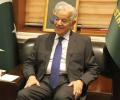
Last week, Information Minister Atta Tarar had said that 24-36 hours were important, fearing a possible strike by India. However, the time passed and there was no action by India.
The tour of the Pakistani side was originally scheduled in October 2018 but was postponed because of local bodies elections in Jammu and Kashmir.
Water flowing into Pakistan from the Sutlej, Ravi and Beas can be stopped only if three dam projects on this side of the border are completed.
Assistant Secretary of State for South Asian Affairs Robert Blake said Pakistan had frequently raised the controversial and contentious water issue with India during his recent trip to Islamabad, but added that the US had no intention of intervening in the bilateral issue.
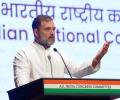
The Bharatiya Janata Party on Wednesday slammed Rahul Gandhi for his 'surrender' barb at Prime Minister Narendra Modi, saying it is not only a grave insult to the armed forces and country but also no less than treason.
Islamabad should purchase water from India to save 50 million people in southern Punjab, the MPs said.
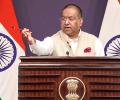
External affairs ministry spokesperson Randhir Jaiswal said India will keep the IWT in abeyance until Pakistan "credibly and irrevocably" abjures its support for cross-border terrorism.
